

UXMA @ IAA 2026

Four of our colleagues from Hamburg and Dresden spent a day at the IAA TRANSPORTATION in Hanover. In this article, they’ve shared their impressions of the world’s leading international trade fair for commercial vehicles, transportation, logistics, and buses.

Two persons talking about interfaces in cars.

What we expected?

With more than 140,000 visitors and 1,500 exhibitors from 46 countries, IAA TRANSPORTATION has a lot to offer. In addition to world premieres, numerous vehicles, and talks, Ellen Geißler (Senior UX/UI Designer), Finn Lassen (Interaction Designer), Constantin Kärgling (Industrial Designer), and Christian Jakobs (Senior Industrial Design Engineer) were particularly interested in physical interfaces, buttons, touch controls, benchmarks, and current trends. That’s why their motto was, above all: testing, testing, testing.

Three persons in a truck, testing the functions.
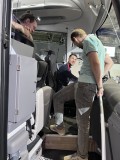
Three persons in the cabin of a truck, testing the functions and talking about it.
A person inside of the cabin of a truck, testing the functions.

3D in Vehicle HMIs: Added Value or Just a Gimmick?

3D renderings and animations are increasingly becoming standard tools in vehicle HMIs. The added value is obvious: A 3D model fosters a sense of connection with one’s own vehicle, makes spatial relationships (e.g., trailer hitch, environmental sensors) intuitively understandable, and brings clarity to user guidance where text or 2D icons reach their limits. Especially in complex commercial vehicles with many hidden functions (e.g., trailers, load securing), a three-dimensional model can build trust and reduce abstraction. The vehicle is “understood” rather than just symbols being read.

In practice, however, it becomes apparent that this opportunity is rarely utilized consistently. We have observed instances of differing presentation styles within a single HMI. Furthermore, some displays appeared cluttered at times when a fully rendered interior was shown, even though only a single function was being addressed.

Finn Lassen Interaction Designer

Two persons testing an interface and the different buttons.

Ellen Geißler Senior UX/UI Designer

Safety first – everywhere!

No one at the trade show could ignore the topic of safety. Particularly striking was the variety of tracking systems on display at numerous booths. These systems not only keep an eye on the road but also monitor drivers’ concentration, assist with maneuvering, and protect the vehicle from unauthorized access.

As the level of automation continues to rise, truly innovative approaches to human-machine communication are emerging at the same time:

  • The seatbelt that thinks for itself: If the driver’s gaze strays from the road for too long, the interactive seatbelt alerts them with a sharp tug.

  • Light as a language: LED strips integrated into the interior trim use animated light effects to alert drivers to dangers outside the vehicle or simply create a relaxing atmosphere.

  • Maneuvering from a bird’s-eye view: Thanks to exterior sensors, real-time 3D animations are generated that show, for example, the loading area—including all obstacles—from above. This makes maneuvering significantly safer.

  • Headquarters is in on it: Other suppliers are focusing on connecting vehicles to headquarters. There, video footage is analyzed in real time, and suspicious behavior patterns are detected. This allows potential burglars to be deterred by an alarm before any damage occurs.

With so much data being collected, one key question naturally arises: What happens to it? This was addressed on one of the panels dedicated to data security and AI support. Among other things, the discussion focused on how to handle the vast amount of sensor data as responsibly as possible and what added value can be derived from secure connectivity.

Constantin Kärgling Industrial Designer

Hardware and software rarely work together seamlessly

One trend was clearly evident at the IAA: buttons and knobs are making a comeback, while touch-only cockpits are on the decline. This aligns with an industry-wide trend, as new Euro NCAP requirements will mandate physical controls for basic safety-related functions starting in 2026.

Things get particularly exciting when hardware and the UI don’t just coexist side by side, but actually interlock—such as with a rotary control integrated into the display or buttons below the screen that directly affect the UI above them. Renault and Kia have demonstrated positive examples in this area, but such solutions remain the exception so far. Most often, hardware and software seem like two separate worlds that were only brought together as an afterthought. There is also often too little common ground in their design language.

Two persons at a stable at IAA for digital interfaces of cars.

From a Hot-Button Issue to the Norm

Unlike in previous years, AI and autonomy were no longer staged but were present and could be experienced in a completely natural way. Robo vans without a traditional driver’s cab made their debut, automated driving was demonstrated live along Expo Allee, and the conference program—featuring over 200 speakers—addressed AI and software-defined vehicles as fundamental themes of the industry. For us, this was a very clear sign that these technologies have just made the leap from hype to the new normal, even if the concrete UX implementation is still lagging behind.

  • The outside area of the IAA with autonomous driving cars.
  • A person inside of a bus, looking at the interior design.
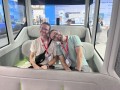
  • Two persons smiling and sitting close to each other in an autonomous driven car.

What we’re taking away

After a day at the IAA, our main takeaway is that while the technologies are certainly there, what really matters is how well they integrate within the vehicle. 3D can make complex functions easier to understand, physical controls can enhance safety and control, and AI and sensor technology open up new possibilities for assistance. However, it’s becoming clear that it’s not the sheer number of technologies used that will determine the future of mobility, but rather how intuitive and safe they are for people to use.

Insights

Project idea? Get in touch!