Discover Your Baltic Sea Vacation Digitally

UX/UI rebranding of the Ostsee Guide app

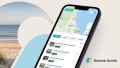
Image of a cell phone screen displaying the new Baltic Sea Guide app (home screen showing a map section of the Scharbeutz region)

Through a comprehensive UX/UI redesign, the Ostsee Guide has been transformed into a modern, intuitive experience platform. Thanks to its clear information architecture, users receive more personalized information about their vacation destination.

  • 4

    project duration in months

  • 5

    parallel AI agents

  • 1

    interactive prototype with numerous features

  • 4

    project duration in months

  • 5

    parallel AI agents

  • 1

    interactive prototype with numerous features

What was our task?

The Ostsee Guide app needed a complete redesign including branding, a refreshed user experience and a fully clickable prototype. At the same time, we had only a few months to complete the entire project. This meant that, in addition to a tight timeline, we had to implement the client’s requirements and decisions in line with the design process. Using traditional UX and UI processes, the desired level of detail would have been nearly impossible to achieve within the available time, so we had to rethink our approach.

New workflow with prototype

Given the time-limited conditions, we made a conscious decision to adopt a new workflow. Instead of first designing all the screens in Figma and subsequently creating a prototype, we reversed the process.

We created an early, deliberately rough version of the interactive prototype using various AI tools. This initial prototype was then iteratively expanded, tested and refined. The necessary screens were subsequently developed manually in Figma, finalized and transferred to the clickable prototype. This meant we didn’t have to design all screen variations in full from the start, but only had to manually refine them where it was truly necessary.

In addition to the prototype, internal UX tests were conducted to identify logical gaps and further optimize the app’s intuitive usability.

Since the interaction logic and product knowledge were already embedded in the prototype and the AI sessions, the documentation could also be built upon this foundation. The finished prototype thus became the basis for the project documentation.

Simeon Ortmüller Senior Experience Designer | AI Specialist

AI as a catalyst for development

The true innovation in this project was not only in the final design, but in the development process itself. Thanks to the AI-supported workflow, the prototype, design and documentation could be developed in parallel. This enabled us to create an exceptionally detailed and nearly production-ready prototype within the tight timeframe.

This prototype already gave our client a clear idea of what the app’s redesign would look like, as it covered all relevant usage scenarios.

The new logo for the Baltic Sea Guide.
Image of the digital ostseecard within the Ostsee Guide app.
Images illustrating the design changes. Before-and-after graphics of the app screens for the home screen and map view.

A relaxing vacation just a few clicks away

Within just a few months, this innovative process resulted in a completely revamped concept for the Ostsee Guide app – including a new corporate design, UX concept, UI design, clickable high-fidelity prototype and comprehensive project documentation. The redesigned app is more closely aligned with users’ needs and offers an interactive experience for discovering places and events throughout the Baltic Sea region.

When using the Ostsee Guide, this is most evident in a significantly clearer information architecture and a modern, consistent user experience. The integration of the OstseeCard was also redesigned and is now visible on every screen and easy to find.

In the future, a planned AI daily itinerary feature will allow users to plan a full day’s itinerary with multiple stops and additional recommendations in advance and then guide them through it in execution mode.

There was also clear added value from the customer’s perspective. The Ostsee Guide app was better differentiated from the Lübecker Bucht brand. At the same time, opportunities for future monetization of the app were taken into account to support the application’s scaling down the line.

In the future, a planned AI daily itinerary feature will allow users to plan a full day’s itinerary with multiple stops and additional recommendations in advance and then guide them through it in execution mode.

There was also clear added value from the customer’s perspective. The Ostsee Guide app was better differentiated from the Lübecker Bucht brand. At the same time, opportunities for future monetization of the app were taken into account to support the application’s scaling down the line.

Forecast and conclusion

This project has shown us how AI can not only speed up individual work steps but also reorganize the entire UX and UI process. Instead of working through linear design phases one after another, we developed an iterative workflow in which prototyping, design, documentation and concept development are intertwined. This enabled us to develop complex digital products in much greater detail and in less time, without compromising on conceptual quality or the user experience.

We continue to follow the expansion of the Ostsee Guide app with great interest and are pleased to have made a significant contribution to this regional project.

Illustration of the Baltic Sea Guide app within a graphic featuring the newly developed brand design.

Portrait Paul Stellmacher - Tourismus Agentur Lübecker Bucht

Paul Stellmacher Deputy Board | Head of Department Online Marketing of Tourism-Agency Lübeck Bay

You can download the Ostsee Guide here:

  • 4

    project duration in months

  • 5

    parallel AI agents

  • 1

    interactive prototype with numerous features

Cases

Project idea? Get in touch!